
Hail Damage Roof Insurance Claims in Fort Collins, CO
Commercial Roofing
Commercial Roofing Services
Hail Damage Roof Insurance Claims for Fort Collins Commercial Buildings
Fort Collins sits inside the stretch of hail alley that runs down the Front Range through Loveland and Greeley, and commercial flat roofs here take direct hits most hail seasons. When that damage turns into an insurance claim, the outcome usually comes down to how well the roof was documented before repairs started and how clearly cosmetic marking got separated from functional damage in that record.
Why Hail Claims Get Disputed More Than Other Storm Claims
Hail is unusual among storm perils because it can leave a roof looking rough without actually compromising it, and it can also leave a roof looking mostly fine while quietly breaking the membrane in a handful of critical spots. That gap between appearance and function is exactly where hail claims get argued. An adjuster looking at surface bruising without a clear functional-versus-cosmetic breakdown may reasonably question whether repair is warranted at all, and an owner relying only on ground-level photos has little to push back with. We build our documentation specifically to close that gap, covered in general terms on our insurance claims page.
What We Document on a Hail-Damaged Roof
Every hail-damage walk starts with a full field inspection, not a sample of a few spots. We mark and photograph each impact point, note whether it's on a single-ply membrane, a built-up cap sheet, or metal panel and edge, and record the pattern of the strikes across the roof. Hail cells moving up the I-25 corridor often hit one slope harder than another, so we document by section rather than assuming uniform damage across the whole field. Drains, scuppers, and rooftop equipment get checked too, since granule and debris buildup from hail is a common secondary issue adjusters ask about.
Cosmetic Marking Versus Functional Failure
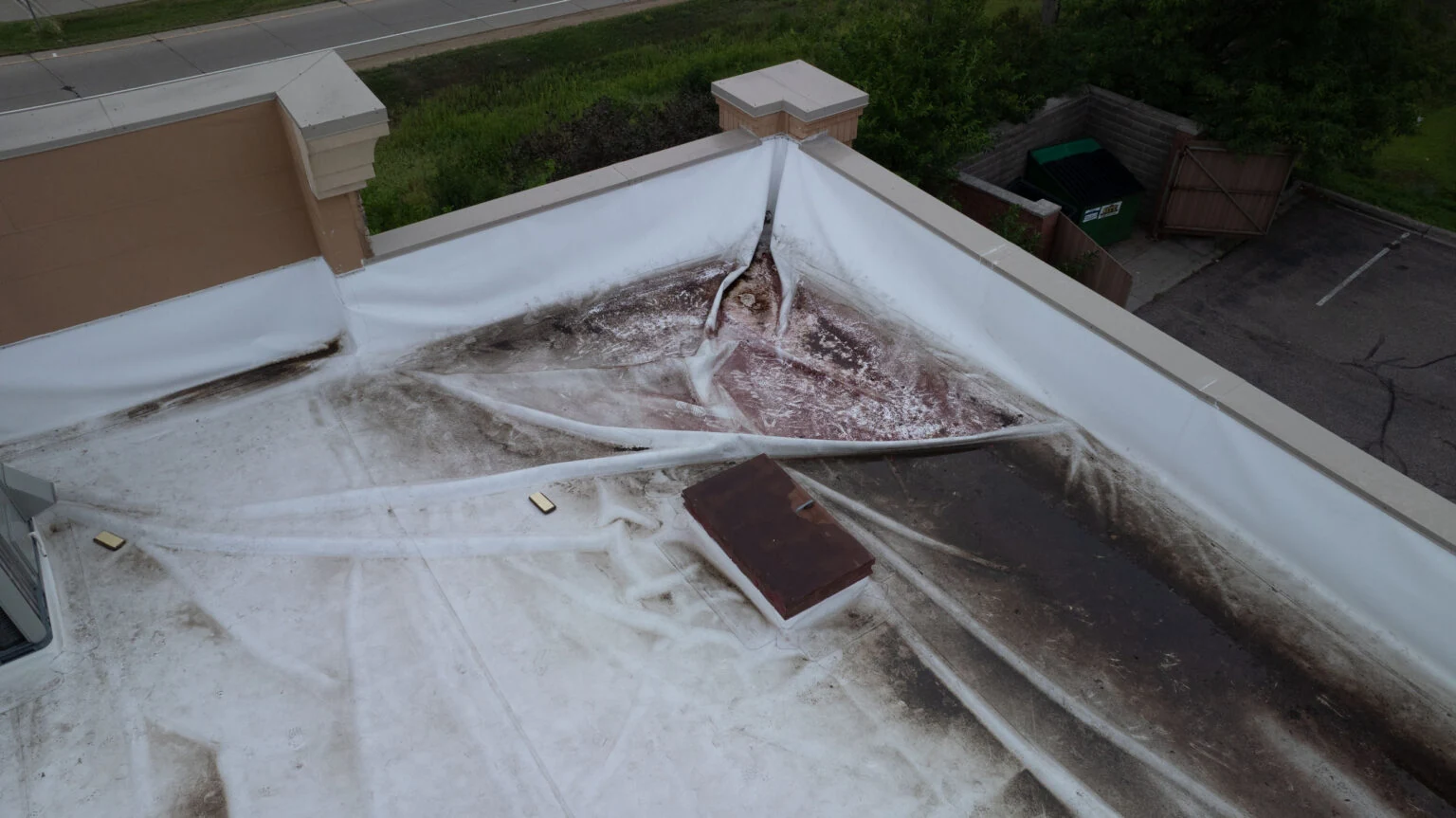
This distinction drives the entire claim. Cosmetic hail damage — granule loss, surface dimpling, minor coating wear — doesn't compromise the roof's ability to keep water out. Functional damage does: fractured scrim, split membrane, cracked seams, punctured panels. We classify every finding into one of those two categories with photo evidence attached, because a claim built on a clear, defensible classification holds up better under review than one that treats every mark the same way. More on how this plays out during repair itself is on our storm damage repair page.
Impact Density and What It Means for Claim Value
A roof with a handful of scattered functional impacts is a different claim than a roof where hail has broken through the membrane across most of the field. We report impact density by section — how many functional hits per square, how they cluster — because that number is often what separates a spot-repair scope from a full reroof recommendation in an adjuster's evaluation. We don't inflate density counts to push toward a bigger scope, and we don't understate them either. The count reported is the count we found.
Timing Matters More With Hail Than With Most Perils
Hail damage that goes undocumented for weeks gets harder to distinguish from ordinary wear, especially on older membranes that already show some surface aging. We prioritize hail-season inspection requests for exactly this reason — the clearest record comes from a roof walked soon after the storm, before additional weather or roof traffic complicates what's visible. If a functional impact is actively letting water in, we handle stabilization first through our emergency tarp and dry-in service and document the rest once the building is secure.
Metal Roofs and Metal Edge After Hail
Metal takes hail differently than membrane. Standing seam and R-panel roofs common on newer Harmony Corridor and industrial buildings show dents rather than tears, and depending on gauge and panel profile, a strike heavy enough can perforate the metal at a seam or fastener line. We check panel field, seams, and metal edge separately during a hail walk on any metal roof, since dent pattern alone doesn't always indicate whether the panel's weather-tightness has actually been compromised.
Our Role in a Hail Claim
We're your roofing contractor, not a public adjuster — we document and substantiate the hail damage so you and your adjuster work from an accurate scope. We don't estimate what a claim will pay, we don't negotiate with the insurer, and we don't promise a particular outcome. Our job is putting accurate, roof-specific evidence in front of whoever is deciding the claim.
Hail Claim Questions From Fort Collins Property Owners
How can I tell if hail actually damaged my roof or just marked the surface?
That's what an inspection is for. We check for scrim fracture, split membrane, and exposed underlayment beyond surface marking, and report which impacts are cosmetic and which are functional.
Does a roof need to show a leak before hail damage counts for a claim?
No. Functional damage often doesn't leak right away — it fails on the next hard rain or when wind drives water into a compromised seam. We document based on what the inspection finds, whether or not the roof is actively leaking that day.
Will you meet the adjuster on the roof for a hail claim?
Yes, and we do it regularly during hail season. We walk the roof alongside the adjuster and hand over our documentation directly for their review.
How soon after a hailstorm should the roof get inspected?
As soon as reasonably possible. Additional storms and normal roof traffic can change what's visible, so an early inspection generally produces the clearest, most defensible record.
What if my roof is older and already has some wear from age?
We separate storm-related functional damage from pre-existing wear in our documentation as clearly as the physical evidence allows. An older roof can still have a legitimate hail claim on top of normal aging.
Roof
GALLERY