Commercial Roof Drainage and Ponding Repair in Fort Collins
Commercial Roofing
Commercial Roofing Services
Roof Drains and Scuppers for Fort Collins Flat and Low-Slope Roofs
A flat commercial roof only works if the water on it has somewhere to go, fast. Drains and scuppers do that job, and on Front Range roofs they take on a specific set of problems — hail granules and debris that clog strainers, freeze-thaw cycling that works joints loose, and seasonal debris load from cottonwoods and other trees common around Fort Collins. We service, repair, and reconfigure roof drainage for commercial buildings throughout the area.
Internal Drains: Clearing, Sump Repair, and Clamping Ring Issues
Internal drains sit at the low point of the roof deck and carry water down through the building rather than off the edge. They fail in a few predictable ways. The strainer basket clogs with granules, leaves, or hail debris and water backs up around it. The clamping ring that holds the membrane sealed to the drain bowl loosens or was never properly seated, and water tracks underneath the membrane instead of into the drain. The sump itself — the slightly recessed area around the drain — can lose its slope over time as the roof deck settles or as recover layers get added without re-establishing proper pitch to the drain.
We check all three on a drain inspection: strainer condition and clearance, clamping ring tightness and seal integrity, and sump slope. A drain that looks fine from a glance at the strainer can still be leaking underneath if the clamping ring isn't seated right, which is why we pull strainers and check the seal directly rather than assuming a clear strainer means a working drain.
Scuppers on Parapet Roofs
Scuppers carry water through a parapet wall rather than down through the roof deck, and they're common on the parapet-wall commercial buildings found through Old Town, Midtown, and a lot of the newer retail construction along the Harmony Corridor. A scupper that's undersized for the roof area it drains, or one that's partially blocked by debris, backs water up against the parapet and creates ponding right where the membrane meets the wall — one of the worst places on a roof for standing water to sit.
We size scuppers to the actual drainage area rather than to whatever opening already exists in the parapet, and we install overflow scuppers set slightly higher than primary scuppers as a backup when a primary drain or scupper clogs during a heavy storm. That overflow detail is inexpensive relative to the water damage it prevents when a primary drain fails during a fast-moving hail event.
Ponding Water and What Causes It
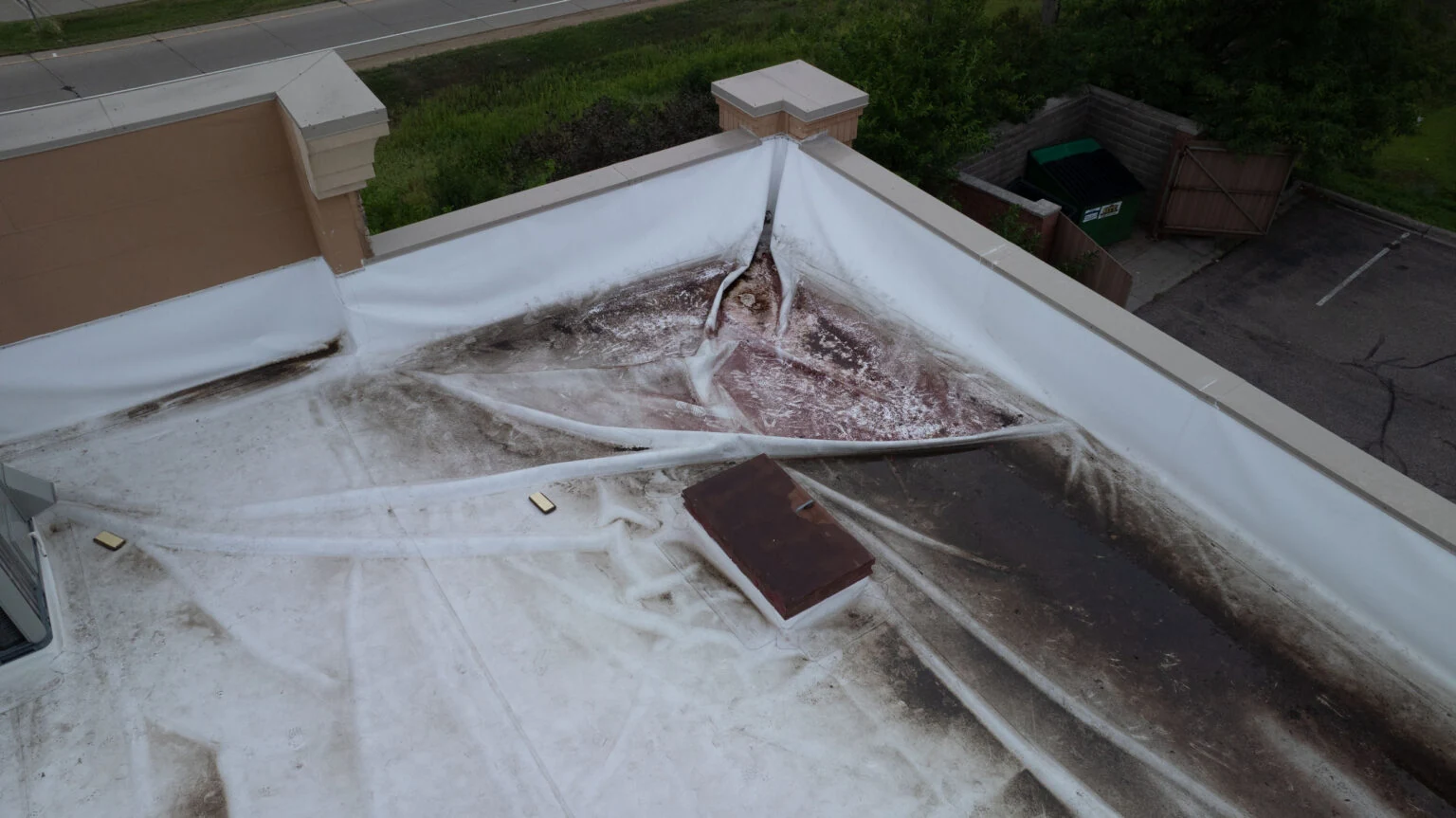
Standing water that doesn't clear within 48 hours after a rain accelerates membrane aging, promotes algae and debris buildup, and adds dead load to the roof structure. Most ponding on Fort Collins roofs traces back to one of a few causes: a low spot in the original deck construction, insufficient slope built into a recover or reroof, a clogged or failing drain, or settlement over time. We identify which of these is actually happening rather than just treating the symptom.
Sometimes the fix is drain service. Sometimes it's tapered insulation added during a reroof to correct slope permanently. We don't push a bigger tapered-insulation job on a roof that just needs its drains cleared and serviced — we diagnose first and recommend based on what's actually causing the water to sit.
Seasonal Debris and Hail Granule Loading
Fort Collins sees real seasonal debris load — cottonwood seed and leaf litter in fall, and after any hail event, a surge of granules washed off the membrane surface that heads straight for the nearest drain or scupper. A drain that handled water fine in June can be substantially restricted by August if it hasn't been checked since spring. We recommend drain and scupper clearing as part of a seasonal maintenance rhythm, particularly after storm season, and we tie that into our preventive maintenance program for buildings that want it handled on a schedule rather than reactively.
- Strainer clearing and clamping ring inspection on internal drains
- Sump slope verification to confirm water actually reaches the drain
- Scupper sizing checked against actual roof drainage area
- Overflow scupper installation as backup protection
- Ponding source diagnosis — deck, slope, or drain failure
- Post-storm granule and debris clearing at all drainage points
Why Drainage Gets Overlooked
Drains and scuppers are easy to ignore because they're small, low on the roof, and rarely inspected on their own — most owners think about them only after water is already backing up. We check every drainage point on every roof inspection we do, whether the visit was called for drainage or for something else entirely, because a clogged drain found early is a five-minute fix and a clogged drain found during a storm is an interior water damage claim.
Drainage Questions From Fort Collins Property Owners
How often should roof drains actually be checked?
At minimum twice a year — spring and fall — plus after any significant hail or wind event, since granule and debris loading spikes after storms.
My drain strainer is clear but I still see ponding. What's going on?
That points toward either a clamping ring seal problem or a slope issue in the sump, not a clog. We check both when a clear strainer doesn't explain the ponding.
Do all commercial roofs need overflow scuppers?
Not all, but it's a low-cost safeguard on any roof where a single primary drain or scupper failing could mean significant water backup, which describes most flat commercial roofs here.
Can ponding water actually damage a roof, or is it just cosmetic?
It's functional, not cosmetic. Standing water accelerates membrane breakdown, adds structural load, and often signals a slope or drainage problem that gets worse if left alone.
Do you handle drain and scupper repairs on roofs you didn't originally install?
Yes. Drainage repair and service isn't tied to who installed the roof — we work on existing systems regardless of the original installer.
Roof Drainage and Ponding Review for Fort Collins commercial properties starts with the condition in front of the owner. The field record must explain slow roof drains, blocked strainers, backed-up leaders, leaking drain bowls, undersized scuppers, missing overflow paths, or ponding that remains after rainfall, separate immediate protection from permanent work, and show how the findings affect repair, restoration, replacement, maintenance, and future capital decisions.
Carry today's evidence into the next roof decision
The practical handoff is a roof-condition review that connects drainage failures to membrane and insulation performance. The next person should receive the property address, roof-area identifiers, contacts, access notes, photographs, temporary measures, completed work, open recommendations, and timing. For one building, that history makes the next visit faster and reveals whether a repair held. Across a portfolio, it lets ownership rank roofs by condition, operational risk, repair spending, and capital timing instead of reacting to the newest ceiling stain. The result is more than a completed patch or proposal. It is a controlled sequence from immediate response to documented condition, from condition to an appropriate option, and from that option to scheduled stewardship of the roof asset.
Give the first call enough information to work
A useful intake for Commercial Roofing Contractors of Fort Collins identifies who can grant access, where water is entering, what operations are affected, whether electrical or ceiling hazards exist, how the symptom changes with weather, and which roof records or photographs are available. Interior photographs can preserve stain limits and active-drip locations before ceiling materials are moved. Roof photographs from facility staff may help with orientation, but they do not replace safe field verification or authorize untrained personnel to enter the roof. The response plan should match the reported condition without promising a cause, permanent repair, or arrival time that has not been verified. Dispatch clarity is valuable precisely because it avoids unsupported assumptions.
Make allowances and exclusions visible
A proposal should distinguish verified quantities from allowances and investigation from construction. Roof area, repair limits, test cuts, wet-material removal, deck repair, drain work, equipment coordination, and interior protection can carry different pricing certainty. Alternates are useful when they compare real decisions, such as repair versus restoration preparation or recover versus tear-off. They are less useful when major necessary work is moved out of the base price simply to make one proposal appear lower. Closeout requirements should be priced as part of the work: final photographs, repair locations, warranty or material records, open punch items, and the next recommended inspection. Those documents keep the completed scope connected to the roof plan.
Connect the roof problem to the building and weather
A Fort Collins roof review has to account for hail exposure, snow, rapid temperature swings, high ultraviolet exposure, and freeze-thaw movement. Those conditions affect access, observation timing, drying, and temporary protection before they affect the final recommendation. Interior evidence should be mapped to a roof elevation before anyone chooses a drain, wall, curb, seam, penetration, or edge as the cause. Water can move laterally through insulation, along deck flutes, or down structural elements and appear away from the opening. This distinction protects the owner from treating a correlation as proof. It also lets the next technician revisit the precise unknown instead of repeating the entire investigation.
What the field record must establish
The core deliverable is a record of water depth and duration, debris, drain and scupper condition, membrane terminations, interior staining, discharge restrictions, roof slope, overflow provisions, and repeated ponding locations. Commercial Roofing Contractors of Fort Collins should be able to hand that record to ownership, a facility manager, or another contractor without a separate verbal explanation. The field sequence is to follow water from the roof field through low points, sumps, drain bodies, clamping rings, scuppers, leaders, overflow openings, and safe discharge points. Photographs should show context and detail, and test locations should explain what question was being answered and how the opening was closed. Observed facts, recommended actions, completed work, and open items should never share one unlabeled list. Separating them lets an off-site approver see exactly what was authorized and what still needs a decision.
Roof-system details change the diagnosis
Roof-system identification changes the diagnosis. Around Fort Collins, the target page inventory includes Modified Bitumen Sbs, Modified Bitumen Systems, and EPDM Black, each with its own seam, flashing, fastener, and compatibility questions. Preparation and repair language must fit the substrate. Cleaning, drying, reinforcement, fastening, priming, welding, adhesion, and cure requirements should not be copied from one roof system to another without verification. Drainage stays in the analysis because a sound patch cannot correct water held against a curb, an overloaded outlet, or settlement at a low point. System language should support whether cleaning is enough, whether a drain or flashing detail needs repair, or whether chronic slope and capacity problems require redesign instead of functioning as a product catalog.
Plan access, interiors, tenants, and daily dry-in
A technically correct detail is only part of the job at Fort Collins properties such as General Contractors, Insurance Restoration, and Education Facilities. The plan also has to protect people, inventory, equipment, and normal access below the roof. The pre-work review should locate safe access, occupied areas, shutdown constraints, fire or security procedures, rooftop equipment, pedestrian controls, and interior protection. The building contact should know which decisions are needed before mobilization. Wet-weather work may stop at stabilization because permanent materials need a clean, dry substrate and a workable forecast. Daily closeout should state what was opened, completed, and left under temporary protection.
Separate immediate service from capital work
Before pricing becomes the focus, ownership needs an answer to whether cleaning is enough, whether a drain or flashing detail needs repair, or whether chronic slope and capacity problems require redesign. That answer should define the boundary between service work and a capital project. Decision thresholds include moisture extent, remaining secure attachment, deck condition, prior repair performance, drainage, assembly compatibility, operational risk, budget timing, and the period the owner expects the roof to remain in service. A smaller scope is not automatically prudent, and a larger scope is not automatically safer. The defensible option is the one whose boundaries match the documented condition and the owner's operating requirements.
Fort Collins decision checklist
- Map the interior symptom to a named roof area before selecting a repair detail.
- Record temporary measures separately from permanent work and list every open item.
- Verify drainage, penetrations, walls, edges, earlier repairs, and transitions around the affected area.
- State the observed roof assembly, unknown construction, access limits, and testing assumptions.
- Connect the recommendation to repair, restoration, replacement, maintenance, or capital-planning thresholds.
- Set the next inspection or follow-up date so the roof history continues after this visit.
Commercial roof decision questions
Does this condition automatically mean the roof must be replaced?
No. The review should establish whether cleaning is enough, whether a drain or flashing detail needs repair, or whether chronic slope and capacity problems require redesign. Replacement becomes a defensible recommendation only when the field evidence, moisture, assembly condition, repair history, deck or attachment concerns, and lifecycle comparison support it.
What should the Fort Collins roof scope document?
It should document water depth and duration, debris, drain and scupper condition, membrane terminations, interior staining, discharge restrictions, roof slope, overflow provisions, and repeated ponding locations. It should also label temporary and permanent work separately, state assumptions and exclusions, and identify the inspection or service step that follows the current scope.
How does an urgent call become a maintenance or capital plan?
The immediate visit creates the first roof-area record. A follow-up inspection establishes condition and priorities. Completed repairs, recurring observations, drain service, warranties, and future recommendations are then retained so maintenance stays scheduled and larger work can be placed into the appropriate capital year.
Next steps
Roof
GALLERY